Monday, August 27, 2012

Kandy & Sigiriya, Sri Lanka


While it’s only two hours away from Malaysia, it feels like its worlds away. The climate, the animals, the people, the food, its all so different, but all so nice.

We met a nice Singaporean tourist at the airport who offered to share a taxi with us to the city of Kandy where we would be starting our time in Sri Lanka. The 70km four and a half drive was long but fun (yeah that’s right, about 20km per hour). Driving was a little erratic to say the least. We watched as a car passed us while we were passing another car (i.e. car passing a car that is passing a car), and all this with only one lane going each way. We stopped on the side of the road to buy freshly picked cashews, had a quick break for some amazing rice and curry and got an impromptu herbal and spice garden tour.


The herb and spice garden is where spices and herbs are grown for Sri Lanka’s primary source of traditional medicine, Ayurveda. Our guide showed us the garden where the herbs are grown and explained how they can be used for medicinal purposes. After the tour of the garden he showed us how the final products work. He had us drink different teas, asked his assistants to massage us with special lotions and covered us with an assortment of perfumes. After the demonstration was over he tried to sell us all the different types of products. We chose to leave a tip but and not buy anything as we couldn’t really carry it around for the next nine months.


Kandy is the second biggest city in Sri Lanka, but that isn’t saying much, you can walk around the entire town in a couple of hours. It is home to the Temple of the Sacred Relic Tooth. This is where they house a tooth from Buddha that was taken from his cremation before it was burnt. Wars have been fought over this tooth for centuries and worshipers come to this temple all year long to make offerings to the Buddha. Everyone is dressed in white to see the tooth, and the number of people and pushing to get a glimpse at the stupa where the tooth is held is a little overwhelming. We quickly learnt that there would be no personal space in Sri Lanka!


Kandy is a beautiful city with lots going on. We saw four elephants in the city on our first day; unfortunately they are often chained and kept in front of temples. We also saw a snake charmer work his magic with two cobras. He also kept a python around his neck for good measure. As soon as the sun sets, the sky is covered with bats coming out of the surrounding forests and caves as they look for food.


With only two days in Kandy, we took in a traditional dance performance. The dancing and costumes were great, but the best part was the fire performances at the end. They perform different acts with fire as a means to demonstrate concentration and devotion to their god. One performer rubbed himself with a flaming stick, while two others walked back and forth over a bed of burning coals. It was pretty crazy to see something like this live.


The next morning we made our way to the most hectic bus terminal ever and hopped a local bus to Sigiriya where we would be off to explore another ancient ruin and temple. The bus terminals have no schedules or order, buses are parked everywhere, constantly blocking the next bus from being able to leave and they only really leave when they are full. Which by western standards means 175% capacity. People are everywhere, hanging out the doors, standing in the isles, sitting on each other’s laps, it is unreal. Definitely no personal space! We had to transfer busses at one point; from this point until our final destination our bags would be tied to the roof of the bus. 

Luckily everything worked out and we arrived after a hectic two hours and found a nice guesthouse. Our guesthouse, Lakmini, was great. They had built a treehouse so we could sit outside and have breakfast with a great view of the Sigiriya rock. In the morning you could watch as monkeys and peacocks ran wild in the field behind the guesthouse.  

Sigiriya was also great, but hot, hot and dry. The kind of dryness you get when it hasn’t rained for a single day in nine months. There are two things to do here, visit the Sigiriya rock temple and visit the Minneriya National park. We did both.


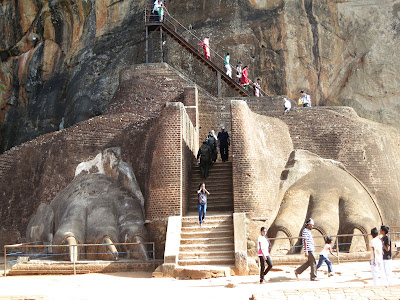
The rock temple is a former fortress which was then converted into a Buddhist monastery; the history dates back to the fourth and fifth centuries. From the bottom it just looks like a giant rock. But as you get closer you see the water and boulder gardens, the caved out caves, the giant wall covered in plaster so they could paint, the ancient frescoes and the giant lion paws that greet you as you arrive on the summit. It is incredibly impressive, especially when you expect so little!


The next day we headed to the Minneriya National Park to go elephant spotting. Each August and September, when the lakes have dried out, the elephants come to eat the grass that grows from the last drops of water from the lake. The event is called "The Gathering". Herds of 50+ elephants can be seen at any given time. We were fortunate enough to see up to 80 elephants at the same time. An amazing site to be seen!


We were even lucky enough to see some more wild elephants on the ride back into town. We had been warned we cant walk the streets at night as elephants sometimes cross through the village; a couple of years ago some villagers were killed when they ran into some elephants around a blind curve in the road. After seeing the elephants only a couple of kilometres from town, we make sure to take those warnings seriously!


Friday, August 17, 2012

Malaysia & Singapore


After having spent two months in slow paced, friendly and chaotic Indonesia, we were a little taken back on our arrival in Malaysia. The pace was quite different, things were more expensive and we were now in our first large Asian city, Kuala Lumpur (KL). KL was a different pace than what we had been accustomed to, lots of traffic, giant shopping malls everywhere and large distances to travel in order to see the sites. Never the less, we did our best to see the sites: Petronas Towers, Chinatown, Shopping Malls and Mosques.


The best part was the food; we feasted on dim sum for breakfast, Chinese soups for lunch and Indian curries and naan for supper. 


We also tried our first (and last) fish pedicure – not very pleasant…


After our time in KL, we hopped a bus to Melaka, a UNESCO heritage city. Melaka is a small, slow paced town with not much going on. 


Fortunately for us our guesthouse was amazing, the staff was incredible and they gave us a map with all the best restaurants in town. We ended up making our three days stay in Melaka more of a food tour than anything else. We tasted Chinese fondue in peanut sauce, Laksa (coconut milk, tuna and shrimp soup), Cendol (shaved ice covered in palm sugar and red beans), and our favorite, Tandoori Chicken and Naan.


After this, we headed to Singapore for a brief day and a half stopover. Singapore is a very nice and clean city, but it didn’t really live up to all the hype, except the part about it being really expensive. Singapore has an amazing skyline with incredible hotels and shopping malls, unfortunately for us, we couldn’t afford to stay or shop in any of them! 


We did take in the Botanical gardens and the Orchid garden, where we got to see the orchid named after Jean Chrétien. We also hit up a cheap water park to cool off from the intense city heat! 


At least the food in Singapore was cheap! 


After all this we got to some serious things, hanging out on one of the nicest islands in the world – Pulau Tiomen. This small island has crystal clear water, a couple of simple guesthouses and intense jungle in the middle to dissuade you from doing anything but hanging out on the beach. Oh, and it is also a duty free island, so all the alcohol is cheaper than elsewhere in Malaysia. Needless to say, we extended our two-day stay twice and hung around for five days.


The only reason we left was that it was soon the end of Ramadan, which meant it was the beginning of their holiday season. We were told if you wanted to do any traveling in the next two weeks you would have to move now, otherwise all buses and accommodations would be booked up by locals on their summer vacations. 

We quickly left the island and tried to get to our next destination, but unfortunately for us, all buses going north were sold out for the next six days. Our only option was to take a six hour bus back to KL as no locals vacation in KL. With few options, but lots of time, we decided to shuffle our schedule around and go to Sri Lanka now, rather than after we’ve seen all of Malaysia. I guess this is one of the luxuries of lots of time and access to cheap Asian flights!

Monday, August 6, 2012

Welcome to the Jungle

After a brief flight from Jogya to Medan and a three hour car ride from Medan to Bukit Lawang, we arrived in the Jungle. We were out of volcano territory, and officially in Orang-Utan territory. 


We would stay in this small village for a week. Our plan was simple, take a day to get acclimated to the jungle, spend four days trekking in search of wildlife and then relax for another two days as our time in Indonesia was coming to an end.

We enjoyed our first day in Bukit Lawang by checking out the local market. Locals come together every friday to sell their produce, fish and freshly collected rubber. There are plantations all around the village where locals tap trees (like what is done to collect maple syrop) and collect rubber. It is quite an interesting and smelly site to be seen!


The next day our jungle trek would start. It would prove to be the best day of our entire trek. During this single day of 8 hour trekking we saw Thomas-Leaf monkeys, Black Gibbons, White-faced gibbons, Long-tailed Macaque, monitor lizzards, spiders and 10 Orangutans! We spent the night with a nice international group, 10 of us in all, but unfortunately for us, they all left the next morning, and only the two of us would trek on for three more days.


The next three days of trekking would reveal no wildlife at all. Five hours of trekking on day two, four hours on day three (with a painful 45min barefoot walk through the river bank) and a one hour tubing ride back into town (this was really fun).

Never the less it was a good experience; and like everything else, it had its highs and lows. The food in the jungle was great, its pretty amazing what they can make with such a simple jungle kitchen. Our last night included a side dish of jungle ferns that were freshly picked during our last treck.


And, we always slept by the river which made for nice showers and fun times hanging off the lianas and being pulled by the strong current in the river.


On the down side, the accommodations were extremely basic. Imagine laying a yoga mat over a bed of rocks and calling this your bed for three nights... very painful!


As well, the drinking water, which was boiled river water, always tasted like smoke. It was pretty awful. And of course, the heat and humidity, John was soaking wet within the first half hour of the walk and would just continue to sweat as the day went on, damn that jungle was hot!

We were both quite happy to be back in the village at the end of our trek. What seemed like such basic accommodations before we left, now felt like a 5 star hotel. Not many tourist stay for more than two or three days, so we were quite well known by the end of our visit. We were even invited to break fast with the locals who had been fasting all day for Ramadan (we had been eating all day, but were quite pleased to join and learn about their fasting).

On our last day we treked to the bat cave which was only a couple of KM away. It was an interesting site to see. Full of bats, a couple of spiders and very dark. Lets just say AJ was not a big fan of this place! 


Saturday, August 4, 2012

Jogja

Yogyakarta or Jogja as the locals call it, proved to be the hardest place to find accommodations during our time in Indonesia. We searched for a couple of hours the night we arrived but had to settle with a real dump. There were a couple cockroaches sharing our room with us; they were so big we named them. After three days there we got lucky when the hotel across the road had a room that freed up. We happily moved into a room with hot water and access to a pool for our last four nights in Jogya. It was twice the price, but well worth it!
Jogja is the cultural capital of Indonesia. We spent our week here checking out all the sites. This included tours of the local spice market and bird market where we saw both live and cooked bats (meant to be good for asthma), snakes, crickets, maggots and an endless variety of spices. 


We toured the ruins of the sultan’s old palace, known as the Kraton. It is literally a town within a town where 25,000 people still live today. Our guide was fantastic; he showed us secret tunnels, the underground mosque and the water palace, just to name a few sites. He had toured Prince Charles around the ruins five years earlier, so we felt we were in good hands!  

We also took in the museum of contemporary art as well as a history museum followed by a traditional shadow puppet show just for good measure. 


AJ also got a quick crash course in Batik making. It is a traditional way to colour material, either for clothing or art, using different coloured waxes and then boiling them out to keep the colour. 

A couple of days into our stay we visited the real reasons we came to Jogya, the Borobudur and Prambanan temples. Borobudur is one of the grandest Buddhist temples in the world, while Prambanan is one of the largest Hindu temples in South East Asia. Both of the temples were amazing, however the sheer size and number of temples that make up Prambanan made this our personal favourite. 


After visiting the temples and having toured most of the city of Jogya, we rented a motorbike and checked out the surrounding villages. We ended up in Kota Gede, a small village that specializes in making silver. Virtually every second shop in the town sells hand made silver jewellery, statues and other accessories. What was especially interesting was getting a tour of the silver making process: the extraction process, making silver thread, using the thread to make jewellery by hand and then polishing the final products using the juices from a local fruit. AJ had to buy herself some silver earrings for 8$. We also came across a local market selling fresh pastries that locals were buying for when they would break their Ramadan fasts. We ate about half a dozen of them for 3$, it was a delicious and very cheap lunch! While coming back into town, we noticed a barbershop, and since my hair was getting a little long, I went in for a clean up. It was the best $0.80 haircut I had ever had!

We used the motorbike to head back to Prambanan one night to watch their famous Ramayana Ballet set in front of the Prambanan temples. It turned out the story was the same as the play we had seen in Bali, but it was played out in a completely different manner. 

The motorbike ride in heavy traffic over bridges proved to be pretty challenging. Even driving in the city is pretty nuts, there are bicycles, horses, cars, trucks and motorbikes all over the roads and we’re driving on the opposite side of the road to what we’re used to, but its pretty damn fun too! 


Here is a video AJ put together: 


Wednesday, July 25, 2012

3 Days, 2 Volcanoes, 24hrs of Transport, 9hrs of Sleep

We knew we wanted to see Kawah Ijen and Mount Bromo; both are meant to be spectacular volcanoes in their own rights. Kawah Ijen is where miners hike up the active volcano and down into the crater to mine sulphur. Mount Bromo is a huge tourist attraction with mystical clouds and beautiful viewpoints.

We started with a tree hour bus ride to the ferry that joins Bali and Java. From there we road the ferry for an hour and were fortunate to meet up with a local woman who told us which hotel to go to in order to book a ride to Ijen. We also met a couple of guys from France on the ferry whom we would spend the next two days with and share transportation costs with (most annoying people ever!).

After lots of negotiation and a very short night of sleep, we would depart for Kawah Ijen at 1:30am. We arrived at the starting point of the trail at 3am. From here we had a steep 2km hike up to the rim of the volcano in the rain and darkness. On our path up the volcano we only crossed local miners working the night shift, themselves on their way to the top so they could climb in the crater and fill their bamboo baskets with sulphur. We reached the top in 90 minutes and were fortunate enough to meet a kind young miner, Antonio, who asked us to follow him into the crater.


The whole point of climbing Ijen at night, in the pitch-black darkness, is to see the volcano’s blue flames. 


The inside of the active volcano continues to be so hot that the sulphur gases released are blue. After witnessing the amazing flames, we asked our miner friend if we could go back up to the rim of the volcano. It was here that he explained that the only way out was to go all the way to the bottom of the crater and take a path out from the other side. Going back up where we came down would be too difficult, especially if the winds changed and we were caught in sulphur smoke. Having made it this far, and our “guide” telling us he wanted to show us where he got the sulphur from, we chose to trek on. It was really worth it.


Once we reached the bottom Antonio showed us how he would break off rocks of sulphur to fill his basket. He also showed us the liquid sulphur that still bubbled below our feet. Antonio used to fill his basket with 100Kgs, but has reduced his load to 70Kgs since he had his son; he was all too conscious of the toll his work would have on his life span. The sulphur would be sold back in the village 3 Km away for $0.06 per Kg. This 4hr trek back and forth would net Antonio approximately $4.20. He would do this twice a day, five days a week for two weeks and then rest (he would also do all this in flip-flops as he couldn’t afford shoes).


While in the crater we also had a chance to look at the acid lake. It is the biggest and most acidic lake in the world, with a diameter of over 1km.


With this done, we thanked Antonio, gave him some chocolate and money ($5) as gifts and trekked back to the bottom of the volcano where our driver was waiting. His reaction to our small gifts was incredible, a very special moment for us!


We were back at our hotel by 9am and would be on the road to Mt. Bromo by noon.
The drive to Bromo was supposed to take 4 hours, but because of Ramadan celebrations (Ramadan would start the next day), we were stuck in traffic for hours. We wouldn’t arrive to our guesthouse until 7:30 at night. After a quick bite, a couple of beers and a good hour of negotiating to prevent the tour from all of a sudden changing price half way through, we were off to bed. The drive to Bromo for the sunrise would start at 3:30am. We were quite excited to see Bromo, one of Java’s most famous volcanoes. Unfortunately, everyone else on the planet was equally excited. 


When we reached the look out point for the sunrise, we realized, this would be no Ijen. We were surrounded by hundreds and hundreds of other tourists. Locals were selling trinkets, renting winter jackets (it was pretty cold at the top) and generally looking to make a buck any way they could. Tourists jostled for position to get a good photo, it was nothing like what we hoped for. The view proved to be great, but the experience, mediocre. We watched the sunrise and got back in our jeep and drove to the foot of Mt. Bromo where we would hike up the volcano for a different view. Both were beautiful, but far from natural.


With this done, we headed back to our guesthouse at 8am for breakfast, and were on the road to Yogyakarta by 9:30am. We wouldn’t arrive in Yogyakarta until 10:30pm. It was a gruellingly long drive.

All in all, it was well worth the effort. Despite Bromo’s commercialism, it was still beautiful to see, but it was nothing compared to the adventure that is Kawah Ijen.